AI Porn Games and AI Sex Games: How They Actually Work


Too many roundups promise the ten best AI porn games and deliver ten chat apps with a progress bar.
That is the whole problem with this category. Four completely different products share one search term, and most pages trying to sell you one never bother separating them.
So this is not another ranking. This is the map: what the four types of AI porn games and AI sex games actually are, what the AI is doing in each one, how the technology holds up in 2026, and why adult-game distribution became much less predictable after July 2025.
Then you can decide what you are actually paying for.
What Is an AI Porn Game?
An AI porn game is an adult interactive product where generative AI contributes either to the content you experience or to the way that content was created.
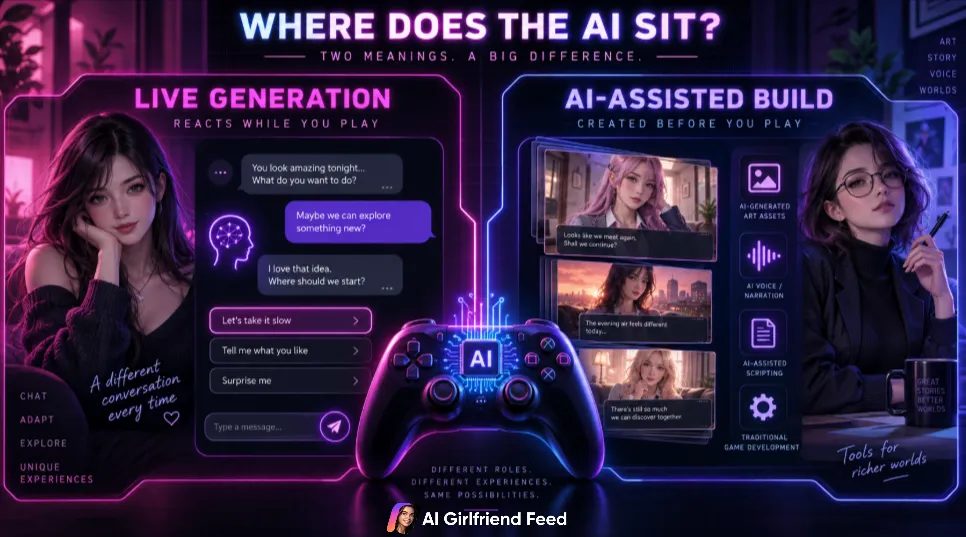
That definition is deliberately broad because the label “AI game” is used for wildly different products. It can mean an LLM generating dialogue live when you type, or it can mean a conventional visual novel where the developer used generative AI for character art, voice lines, backgrounds, or supporting copy.
Both can end up marketed as AI sex games, but they are not remotely the same product.
The useful question is not simply whether a game uses AI. The useful question is where the AI sits and whether it generates anything while you are actually playing.
That distinction decides whether you are getting a system capable of reacting to you or a conventional game built with AI-assisted assets.
The Four Types of AI Sex Games
Most articles collapse this entire category into one list. That makes comparisons nearly useless because a visual novel, AI companion, roleplay engine, and conventional game with generative assets are solving different problems.
| Category | What Drives It | Persistence | Typical Price Model | Best For |
|---|---|---|---|---|
| Adult visual novels with AI assets | Human-authored story; AI may assist art, voice or copy | Usually local or downloadable saves | One-off purchase or creator-supported build | Players who want an authored story and ending |
| AI companion platforms with gamification | Live conversational model plus levels, affection or unlocks | Usually account/server-side | Subscription plus optional credits | Ongoing character interaction |
| LLM-driven interactive fiction | Live model improvising from characters, scenarios and stored context | Depends heavily on memory architecture | Free tier, subscription or self-hosted | Roleplayers and users who want control |
| Conventional games using generative AI | Traditional game engine; AI used in development or sometimes at runtime | Usually conventional game saves | Usually one-off purchase | Players who want actual game mechanics |
Read that table before paying for anything marketed as an “AI game.” The word game is doing almost as much marketing work as the word AI.
Adult Visual Novels That Use AI Assets

These are fundamentally ordinary visual novels with branching scripts, characters, scenes, save slots, and sometimes multiple endings.
The AI is usually in the production pipeline rather than the live gameplay loop. A developer might use generative tools for character illustrations, backgrounds, voice lines, translations, or supporting copy while the actual story remains fixed.
You are still buying an authored product. The AI may have made parts of it faster or cheaper to produce, but it did not necessarily make the game capable of reacting intelligently to what you type.
Nothing is inherently wrong with that. Just do not confuse a game built with AI tools with a game whose actual mechanics depend on AI.
AI Companion Platforms Wearing a Game Costume
This is where the definition becomes slippery.
A conversational model generates the dialogue, then the platform adds affection points, levels, daily rewards, galleries, achievements, gifts, locked scenes, and premium currencies around it.
Now it looks like a game.
Sometimes those systems add meaningful progression. Sometimes they are simply monetization layers sitting above an AI companion.
Reaching affection level eight may unlock a new image or scene without changing the underlying model at all. More unlocks do not automatically mean better AI.
The strongest products can still be genuinely engaging because the same basic technology powers many AI girlfriend simulator experiences. The important thing is understanding whether the progression system changes the relationship or merely changes what you can buy.
LLM-Driven Interactive Fiction
This is the cleanest example of AI being part of the actual experience.
You begin with a character, scenario, or lorebook, and a language model improvises scenes in response to what you type. There may be no traditional dialogue tree because the conversation is generated live.
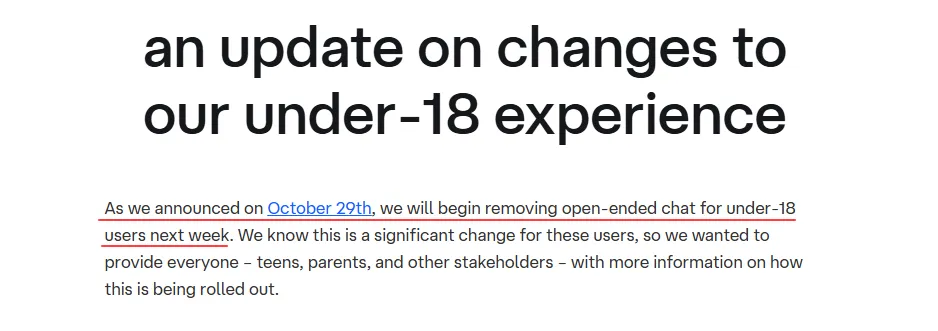
This overlaps heavily with AI roleplay platforms and the Character AI alternatives market. Character.AI announced in October 2025 that open-ended Character chat would be removed for users under 18 no later than 25 November 2025, alongside new age-assurance systems.
Adult roleplay has therefore remained concentrated on adult-oriented platforms and self-hosted setups with different content policies.
There may be no map, inventory, boss battle, or ending. Sometimes it is simply a model, a character prompt, and your typing.
For people who care more about improvisation than conventional mechanics, that can be enough.
Real Games That Use Generative AI
Then there are actual games with engines, mechanics, rules, inventories, win states, movement, combat, puzzles, or conventional progression.
AI may simply have helped create textures, dialogue, voices, or other assets. A July 2025 third-party analysis counted 7,818 Steam titles disclosing generative AI use, showing how common AI-assisted production had already become across the broader game market.
Most of those titles are not adult games, and an AI disclosure does not mean the game uses a live model during play.
A more interesting example is Whispers from the Star, released on Steam on 14 August 2025 by Anuttacon at $9.99. It uses real-time AI-powered conversations as part of the interaction loop rather than limiting AI to development assets.
That is the distinction that matters: a game made partly with AI is not automatically the same thing as a game whose mechanics depend on AI.
What “AI-Powered” Actually Means
On its own, not much.
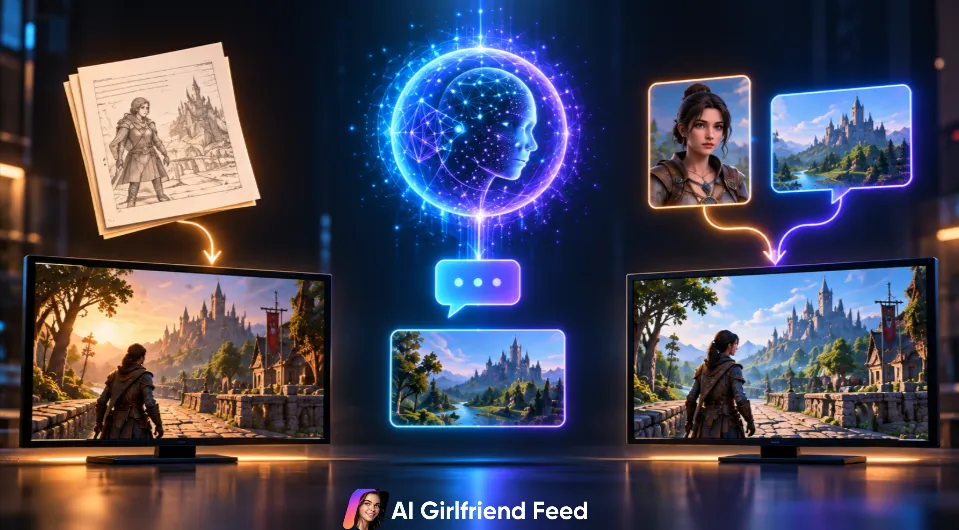
“AI-powered” tells you almost nothing about where generative AI appears in the product. The AI could be generating every reply you receive, or it could have generated three background images during development.
Both can technically support an AI-related marketing claim.
The better way to classify a product is by asking which of these applies:
A deliberately unusual question can sometimes expose obviously fixed dialogue, but it is only a clue. A sophisticated branching system can appear flexible, while a weak LLM can answer badly enough to look scripted.
The stronger evidence is the product's technical documentation, AI disclosure, feature descriptions, and observable behavior together.
The Honest State of AI Games in 2026
An LLM inside a game loop is very good at producing plausible next dialogue.
The difficult part is making that dialogue respect everything that has already happened.
Did the player open the door? Did the character already reveal the secret? Is the sword still in the inventory? Did somebody die three hours ago?
A language model does not automatically maintain a canonical game state just because it has a large context window. A well-built product stores important information outside the model and feeds relevant pieces back when needed.
That can involve explicit state variables, databases, conversation summaries, vector retrieval, pinned memories, character cards, lorebooks, and event logs.
The model handles generation. The surrounding software handles continuity.
Earlier research such as Lost in the Middle showed that simply putting more information inside a long prompt does not guarantee every piece will be used equally well.
Newer models have improved considerably, but the underlying lesson remains useful: a bigger context window is not the same thing as reliable game memory.
This is why memory architecture is one of the most important things to compare between AI roleplay and companion platforms. The model matters, but so do retrieval, summaries, state tracking, and the rules deciding what gets inserted back into the prompt.
A progress meter is easy to preserve. A three-hour improvised relationship containing dozens of facts is much harder.
That is why so many “AI games” are still conversational systems with conventional progression layered around them.
Where AI Porn Games Live After the 2025 Storefront Crackdown
A lot of coverage turned the events of July 2025 into one simple headline:
“Steam banned porn games.”
That is not what happened.
What Happened on Steam
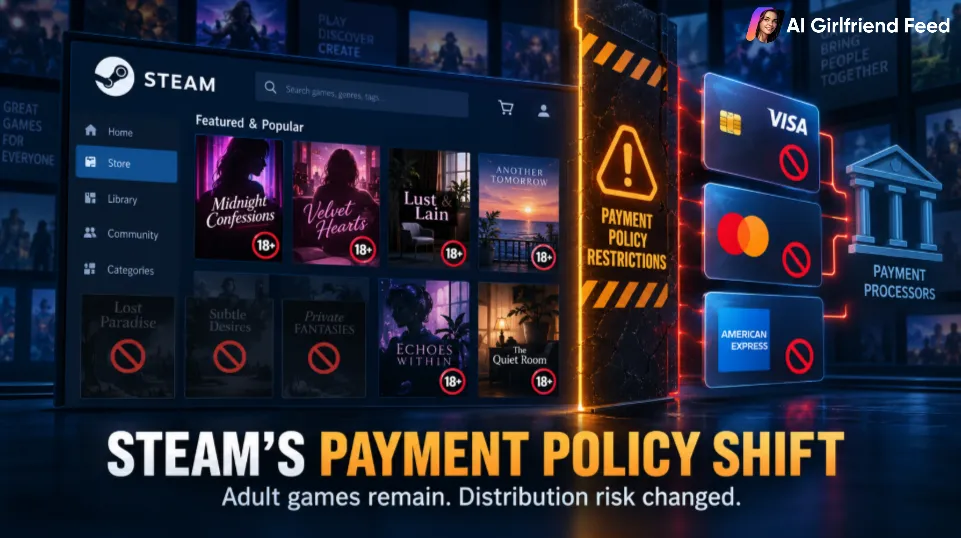
On 18 July 2025, Valve confirmed that it was retiring certain games after being informed they might violate standards imposed by payment processors, related card networks, and banks.
That payment-policy language subsequently became explicit in Steam's publishing rules.
Steam still allows adult content when it is correctly labeled and age-gated. Its rules also prohibit content that may violate standards imposed by payment processors and related card networks, particularly certain adult-only material.
So adult games did not disappear from Steam.
What changed is the reliability of distribution for some categories of adult content. A developer can satisfy ordinary publishing requirements and still hit a payment-policy boundary that has nothing to do with whether the game itself is legal.
That is the real business risk.
What Happened on itch.io
Six days after Valve's statement, itch.io took broader action.
On 24 July 2025, the platform deindexed adult NSFW content from browse and search while reviewing material following scrutiny from payment processors.
itch.io said the action followed a campaign concerning adult content and emphasized that preserving its relationship with payment partners was critical to the platform.
Then came another change.
On 31 July 2025, itch.io began reindexing free adult NSFW content for projects using its No Payments setting. The platform said discussions with payment providers were continuing and that paid adult content would be reintroduced gradually where support was possible.
So the correct conclusion is not that adult games no longer have mainstream storefronts.
The better conclusion is:
Mainstream distribution became less predictable for adult developers because payment-provider rules can determine which kinds of content a storefront is willing or able to sell.
That is a much larger structural issue than one temporary delisting event.
Why Payment Processors Matter So Much
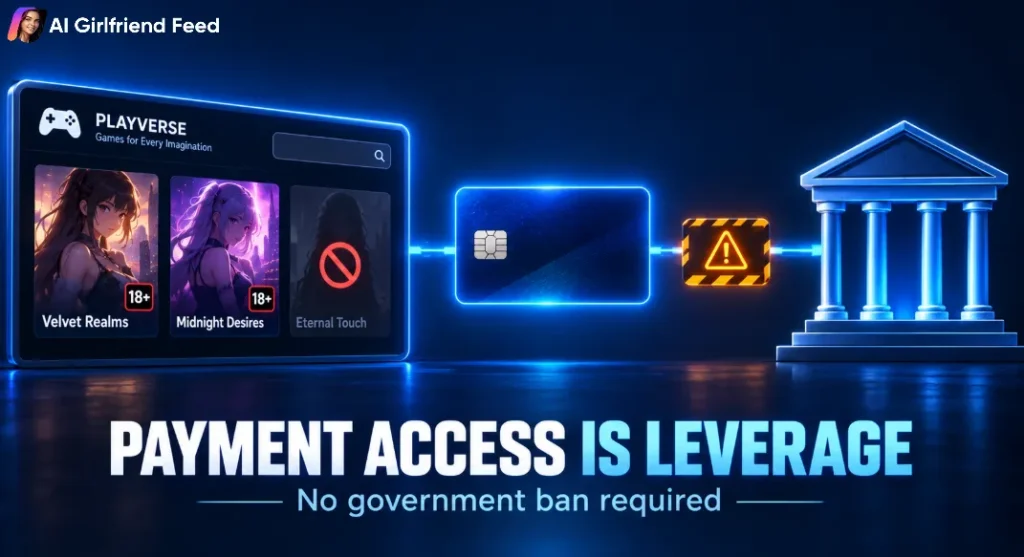
Steam and itch.io demonstrated something adult developers already understood: you do not need a government ban to lose distribution.
A business can also lose payment support, search visibility, store placement, monetization, or access to particular banking partners.
The 2025 controversy involved a campaign by Collective Shout targeting payment companies over adult games, including the controversial title No Mercy, which itch.io had already banned.
Mastercard later denied directly ordering game removals. Valve's position was that payment intermediaries had raised concerns tied to card-network standards.
The argument over who applied which pressure matters politically.
Commercially, the result was simpler.
The storefronts changed their behavior because payment access was at risk.
That is the leverage.
How AI Sex Games Take Your Money
Four monetization patterns appear repeatedly across AI companion and adult-game platforms.
The important thing is not whether one model is automatically good or bad. It is whether the real cost is clear before the user starts paying.
Flat Subscription
This is the easiest model to understand.

Candy AI currently lists its monthly plan at $13.99, while its 12-month option is advertised at $3.99 per month, billed as $47.88 annually.
Premium also includes unlimited text messages and 100 tokens per month.
The advantage is obvious: the recurring base cost is visible.
The remaining question is what those included tokens actually buy and whether ordinary use requires purchasing more.
Subscription Plus Token Top-Ups
This model is common across AI companion products.
The subscription provides core access, while tokens pay for more expensive features such as image generation, video, voice, premium scenes, or custom generation.
That is not automatically a bad pricing structure. Image, video, and audio generation have real infrastructure costs.
The problem starts when the subscription is effectively unusable without repeated top-ups. At that point, the headline subscription price is only part of the real monthly cost.
Energy Meters
Some products give users a limited pool of messages, actions, or energy. Once it runs out, the options are usually to wait or pay.
That creates a game-like form of scarcity around something that may simply be access to generation.
If the meter regularly affects ordinary use, the refill cost belongs in your calculation of the true subscription price.
Gacha and Randomized Unlocks
This is the pricing model that deserves the most scrutiny.
Randomized characters, outfits, or scenes are purchased using virtual currency, often sold in fixed bundles that make the real-money price harder to read.
The EU Consumer Protection Cooperation Network published key principles on in-game virtual currencies on 21 March 2025.
Those principles emphasize clear real-world pricing, avoiding hidden costs, avoiding designs that effectively force consumers to buy virtual currency, and respecting consumer vulnerabilities.
They do not automatically outlaw gacha systems.
They do support one very useful rule:
If a product makes it difficult to translate virtual currency into real money, calculate the real price yourself before buying anything.
The casino arithmetic should not be the user's homework.
What to Check Before Paying for an AI Porn Game
Five questions can eliminate most bad purchases before the card comes out.
1. Does Progress Persist?
Find out what is actually saved and where.
A downloadable game may offer local save files. A web-based AI game may store nearly everything server-side.
Those are very different ownership models.
If the service disappears, the server-side version may disappear with it.
2. Is the AI Part of the Gameplay?
Look for runtime generation rather than the word “AI” on the landing page.
Does dialogue react freely? Are scenes generated dynamically? Does the developer explicitly disclose live AI?
If AI was only used to create static artwork, you are buying an AI-assisted game rather than necessarily playing an AI-driven one.
3. Can You Export Anything?
Check whether the platform lets you export character cards, chat histories, personality prompts, lorebooks, generated images, or save data.
A hundred hours inside a proprietary account becomes considerably less valuable if none of it can leave.
4. What Is the Real Monthly Cost?
Do not stop at the advertised subscription.
Add the subscription, tokens, image credits, voice credits, unlocks, and premium tiers.
Then multiply the realistic monthly amount by twelve.
That is the price worth comparing.
5. What Happens if the Servers Close?
This question separates software ownership from service access.
A downloaded visual novel can continue working after the developer stops updating it. A server-dependent AI game cannot generate anything once the service disappears.
Neither model is automatically better.
But they are not the same thing you are buying.
AI Porn Game vs AI Girlfriend App
These categories overlap heavily, but they are not identical.
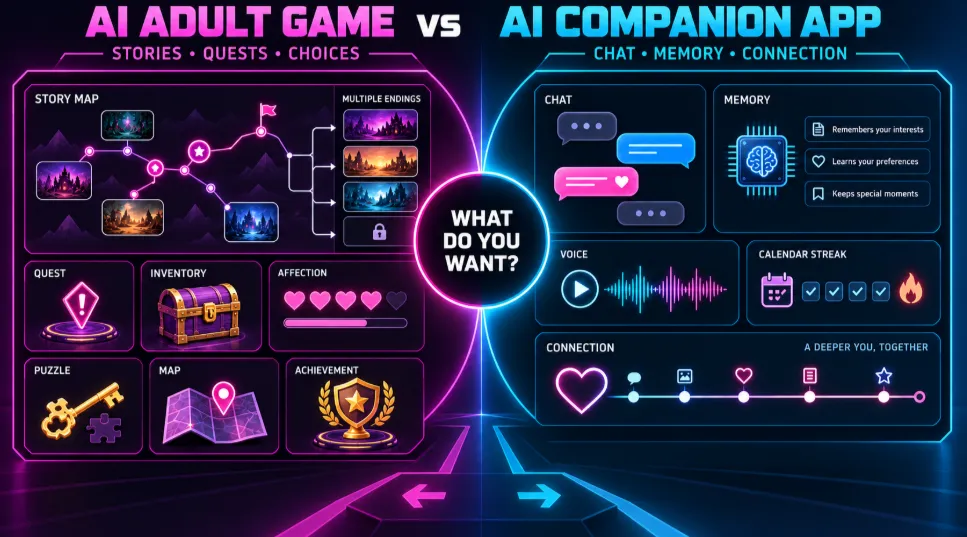
If the main goal is a persistent character and generated conversation, a dedicated AI girlfriend game or companion platform often provides the cleaner experience.
Adding ten currencies and an affection meter does not automatically make the conversation better. Sometimes it only creates more things to buy.
The exception is real game mechanics.
If you want inventory, exploration, quests, consequences, puzzles, combat, or branching endings, conversational AI alone is not enough.
That is where an actual game or visual novel earns the word game.
If the goal is primarily generated adult imagery rather than interaction, an AI image generator is usually the more direct product.
AI Porn Games vs Traditional Adult Games
Traditional adult games and runtime AI games make very different trade-offs.
Traditional games give developers control over pacing, story logic, dialogue, and consequences. Runtime AI gives players more freedom to push the interaction in directions the writer never planned.
| Feature | Traditional Adult Game | Runtime AI Game |
|---|---|---|
| Dialogue | Prewritten | Generated dynamically |
| Story consistency | Usually stronger | Can drift |
| Replay variation | Limited by authored branches | Potentially very high |
| World-state reliability | Controlled by game code | Depends on surrounding state system |
| Offline ownership | Common with downloads | Less common |
| Server dependence | Often low | Usually high |
| Moderation unpredictability | Low | Higher with open generation |
| Ending | Usually defined | May be open-ended |
Neither side wins automatically.
Traditional design is stronger when authored consequences and reliable story structure matter. Generative systems are stronger when freedom of response matters more than perfect narrative control.
The most interesting products will probably be the ones that successfully combine both.
Are AI Games Actually Better Than Normal Adult Games?
Not automatically.
AI increases possibility. It does not automatically increase quality.
A conventional visual novel can deliver better pacing, stronger writing, deliberate foreshadowing, reliable character arcs, and meaningful endings.
A generative system can deliver something a fixed script cannot: the ability to type an idea the writer never anticipated and still receive a response.
That is the real trade.
Authored coherence versus generative freedom.
Most current products still lean heavily toward one side.
FAQ
Are AI Porn Games Legal?
Legality depends on jurisdiction and content. Fictional adult material may be lawful, while age rules, obscenity laws, and distribution restrictions can still apply.
Why Were Adult Games Removed From Steam and itch.io?
In July 2025, Valve removed certain games after payment-partner concerns, while itch.io deindexed adult NSFW content and later began restoring eligible listings.
Do AI Sex Games Actually Remember What Happened
Only when the platform stores and retrieves relevant state outside the model. Memory quality depends on summaries, retrieval, databases, and context management.
What Makes an AI Sex Game Actually AI-Driven?
Runtime generation should change dialogue, scenes, or other content in response to player input. AI-created artwork alone does not make gameplay AI-driven.
Are AI Sex Games the Same as AI Girlfriend Apps?
No. Some are companion apps with progression systems, while others are visual novels, interactive fiction, or conventional games using generative AI.
Is a Subscription or One-Off Purchase Better?
One-off purchases suit fixed stories and downloadable ownership. Subscriptions fit ongoing generated interactions, but yearly cost and export options matter.
The Verdict
AI porn games are not one category, and treating them as one category is why so many roundups feel useless.
A visual novel made with AI art, an AI girlfriend with an affection meter, open-ended LLM roleplay, and a conventional game with live generative NPCs may all appear under the same search term.
They should not be compared as if they solve the same problem.
If you want an authored story, buy the visual novel. If you want a persistent generated character, use the companion platform. If you want open-ended roleplay, prioritize memory and export options. If you want actual mechanics, buy an actual game.
Build Your Ideal Companion Now
Then inspect the monetization, check where your saves live, and find out what can be exported.
Most importantly, check whether the AI is generating something during play or merely decorating a conventional product.
And treat server dependence as part of the purchase.
Because with many AI games, you are not really buying the software.
You are renting access to the system that makes the software feel alive.

Recommended Readings